Our history
In 2011, a small group of Douglas County parents met in a living room to discuss what they were seeing in their neighborhoods. Overdose deaths were climbing. Local hospitals were treating more adolescents than ever for substance-related events. The schools their children attended were doing their best, but health teachers were spread thin and the prevention materials available to them were outdated, fear-based, and often disconnected from what young people actually experienced. That evening they made a decision: they would build something local, honest, and patient enough to make a difference.
Over the next three years the group registered as a nonprofit, recruited a volunteer board, and began publishing simple, plain-language guides for families. The guides were shared in schools, doctor's offices, and libraries. By 2015 we had our first paid staff member. By 2018 we had launched formal partnerships with school districts across the Denver metro area. By 2022 we had begun peer-led recovery support programming for families rebuilding after crisis.
Every step of that growth has been guided by the same principle: we do what our community asks of us, we do it well, and we do not chase scale for its own sake.
Our mission
Our mission is to reduce the impact of drug abuse in our communities by providing honest education, connecting families to trusted resources, and championing prevention among young people. We believe drug abuse is a public-health issue first and a moral question second. We meet people where they are, without judgment, and we build the long-term relationships that recovery requires.
Our vision
We envision a country where every family has the knowledge, tools, and community support to prevent substance misuse, recognize it early, and find compassionate care when it is needed. A country where recovery is expected, not exceptional. Where a young person's first exposure to information about drugs is truthful, age-appropriate, and delivered by a trusted adult.
Our values
- Honesty. We do not exaggerate risks and we do not minimize them. We tell the truth, even when it is inconvenient, because the credibility of prevention depends on it.
- Dignity. Every person we work with—child, parent, person in recovery, family member—is treated as a full human being with a story.
- Evidence. Our programs draw on decades of research from institutions such as the National Institute on Drug Abuse, SAMHSA, and the CDC. When the evidence changes, we change.
- Partnership. We do not compete with schools, hospitals, or other nonprofits. We complement them. Our best work is done alongside people who already know their communities.
- Patience. Prevention is generational work. We measure success in the choices young people make in college dorms, not in the applause after an assembly.
Leadership
ACRDA is governed by a volunteer board of directors that includes parents, educators, licensed clinicians, and community leaders. Day-to-day operations are led by our executive director in partnership with a small full-time staff and a growing network of trained volunteers. Our program advisory committee includes people with lived experience of recovery, whose perspectives shape every program we run.
A current list of board members and staff is available upon request. We are committed to transparent governance and publish an annual report each spring detailing our programs, finances, and impact.
Community impact
Over the past decade, ACRDA educational materials have reached more than 180,000 people. Our school outreach program partners with more than 60 schools across Colorado. Our family workshops have supported thousands of parents and guardians. Our recovery support groups meet weekly and are free to any Colorado resident. None of this is possible without the volunteers, donors, and community partners who share the work.
Future goals
Our current strategic plan focuses on three areas: expanding trauma-informed training for our facilitators, deepening our partnerships with rural school districts across Colorado, and building a stronger digital library of free, Spanish-language family resources. We publish progress against these goals in our annual report.
Why drug prevention matters
The Centers for Disease Control and Prevention estimate that more than 107,000 Americans died from drug overdose in a recent year. The vast majority of adults with a substance use disorder began using substances before age 18. Prevention during adolescence—when the brain is most plastic and habits are being formed—is one of the highest-leverage public-health investments a community can make. It saves lives, prevents suffering, and preserves the human potential of the young people we love.
Why education saves lives
Honest, accurate education does more than warn. It equips. Young people who understand how substances actually affect their bodies and minds, who know how to recognize risk in social settings, and who have practiced the skills to say no are meaningfully more likely to make protective choices. Parents who understand the same information are meaningfully more likely to catch a problem early and respond in a way that keeps their child safe. This is not theory—it is what more than four decades of prevention science tells us.
501(c)(3) tax-exempt status
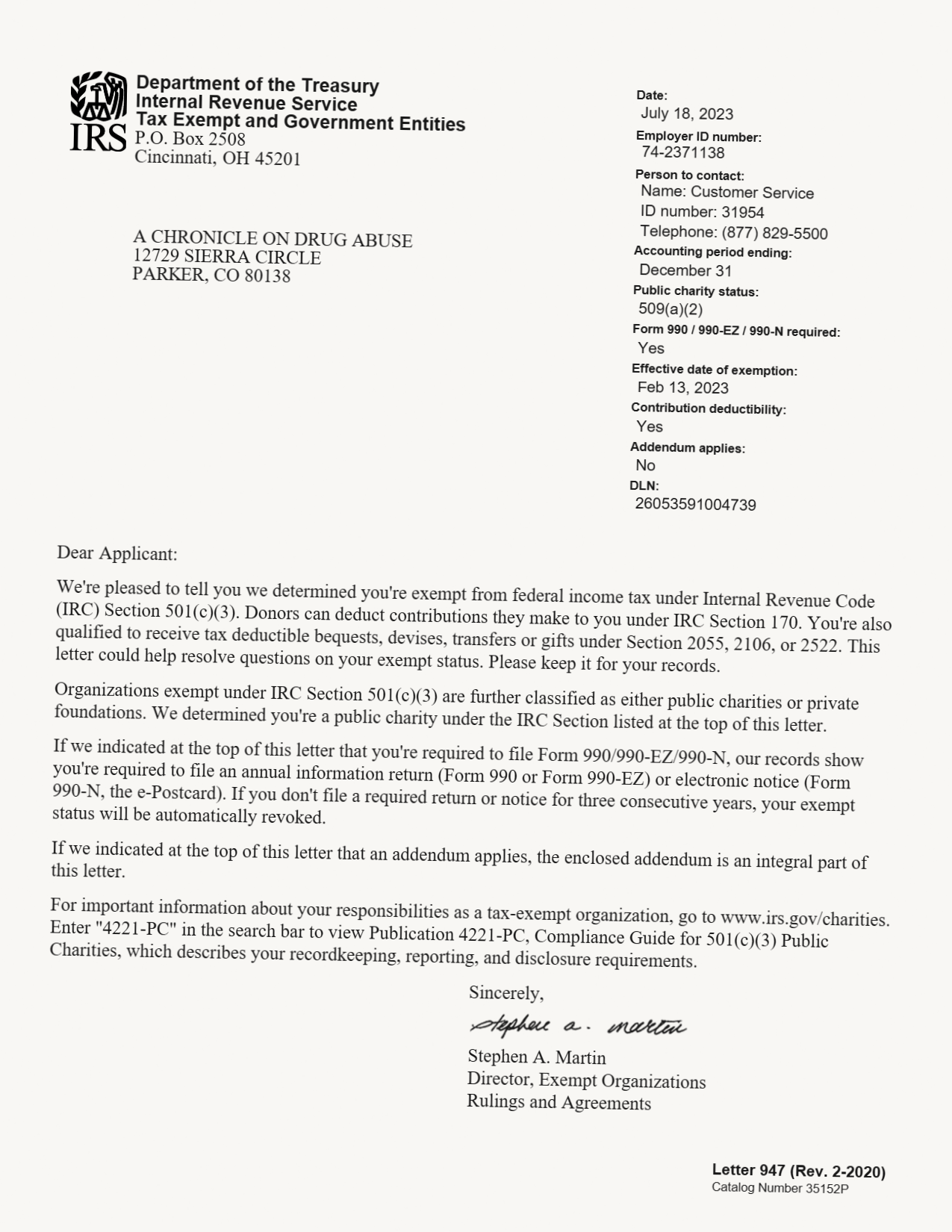
A Chronicle on Drug Abuse is a registered 501(c)(3) nonprofit organization (EIN 74-2371138), recognized by the Internal Revenue Service as tax-exempt under Section 501(c)(3) of the Internal Revenue Code. Contributions to ACRDA are tax-deductible to the fullest extent allowed by law.